VisiVra Review: An Honest, Evidence-Based Look at the Eye Health Supplement
VisiVra is a one-a-day eye support capsule with 21 ingredients, from lutein and zeaxanthin to zinc, vitamins C and E, saffron and ginkgo. Here is what the label shows, what the research says, what it costs, and who might reasonably try it.
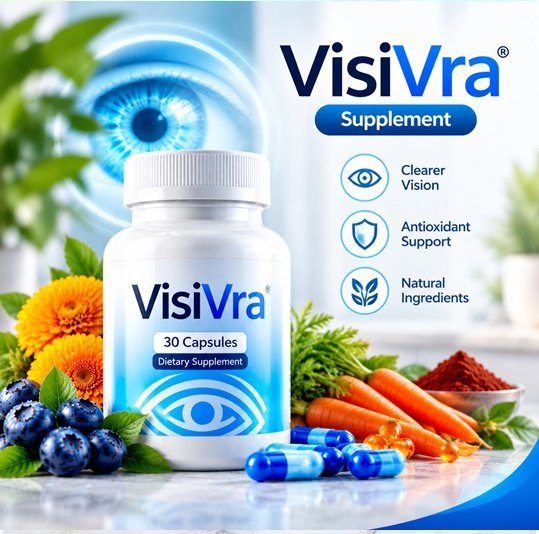
If you have been searching for VisiVra, you have probably seen bold promises about sharper vision, less eye fatigue and protection from screens. This site exists to slow that down. I am Sharon Sam, a biochemist who reviews supplement formulas, and my goal here is simple: give you the facts the sales page leaves out, so that you can decide for yourself whether VisiVra is worth your money.
In short, VisiVra combines a vitamin and mineral base (vitamins A, C and E, zinc, copper, selenium and chromium, all at clearly listed doses) with a 351 mg proprietary blend of 14 botanicals and nutrients, including Lutein, Zeaxanthin, Bilberry Extract, Astaxanthin, saffron and ginkgo. That is a broad and sensible ingredient list. However, the amounts of the headline eye ingredients inside the blend are not disclosed, there is no clinical trial on the finished product, and some marketing claims go further than the science. Keep reading for the full picture.
VisiVra at a glance
| Fact | What we found |
|---|---|
| Product type | Dietary supplement for eye and vision support |
| Serving | 1 capsule daily; 30 capsules (30 servings) per bottle |
| Ingredients | 21 in total: 7 vitamins and minerals with listed doses, plus a 351 mg proprietary blend of 14 botanicals and nutrients |
| Key listed doses | Zinc 11 mg, copper 0.9 mg, vitamin A 450 mcg RAE (as beta-carotene), vitamin C 90 mg, vitamin E 15 mg |
| Blend doses | Not disclosed individually (lutein, zeaxanthin, astaxanthin, bilberry, saffron, ginkgo and others share 351 mg) |
| Packages | 2, 3 or 6 bottles ($79, $59 or $49 per bottle) |
| Shipping | $9.99 on 2 bottles; free in the US on 3 bottles; free worldwide on 6 bottles |
| Guarantee | 60 days from purchase, all bottles must be returned |
| Where sold | Seller’s own website (linked from this site’s order link) |
| Seller support | +1 323-347-4522 · support@tryvisivra.com |
These facts come from the VisiVra Supplement Facts label and from the seller’s order page, refund policy and terms of service, which I reviewed on October 18, 2026. Where something is not stated, I say so rather than guessing.
What is VisiVra?
VisiVra is a dietary supplement sold online as daily support for long-term vision health. The seller describes its formula as “The Ocular Support & Visual Clarity Matrix” and says the ingredients work together to support visual clarity, retinal function, healthy ocular circulation and the eye’s antioxidant defences. Each bottle contains 30 capsules, and the label directs one capsule a day.
Unlike a prescription eye drop or a medical device, a supplement like VisiVra is not reviewed or approved by the FDA before it goes on sale. Under U.S. law, the manufacturer is responsible for the safety and labelling of the product, and the FDA can only act once a product is on the market. That does not make VisiVra bad, but it does mean you should judge it on its ingredients and on the honesty of its seller, which is exactly what this guide does. For a deeper explanation, see What Is VisiVra?.
What is on the VisiVra label?
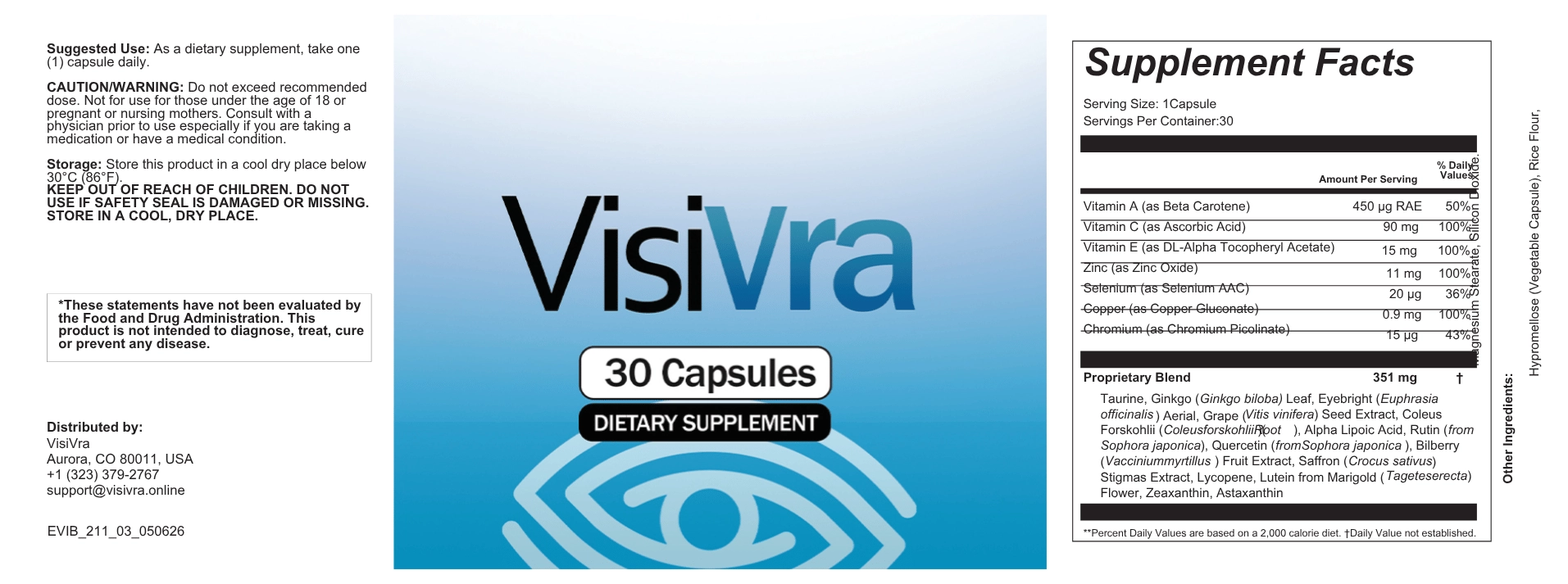
| Supplement Facts (1 capsule) | Amount per serving | % Daily Value |
|---|---|---|
| Vitamin A (as beta-carotene) | 450 mcg RAE | 50% |
| Vitamin C (as ascorbic acid) | 90 mg | 100% |
| Vitamin E (as DL-alpha tocopheryl acetate) | 15 mg | 100% |
| Zinc (as zinc oxide) | 11 mg | 100% |
| Selenium (as selenium AAC) | 20 mcg | 36% |
| Copper (as copper gluconate) | 0.9 mg | 100% |
| Chromium (as chromium picolinate) | 15 mcg | 43% |
| Proprietary Blend | 351 mg | † |
Proprietary blend (351 mg): Taurine, Ginkgo (Ginkgo biloba) leaf, Eyebright (Euphrasia officinalis) aerial parts, Grape (Vitis vinifera) seed extract, Coleus forskohlii root, Alpha lipoic acid, Rutin (from Sophora japonica), Quercetin (from Sophora japonica), Bilberry (Vaccinium myrtillus) fruit extract, Saffron (Crocus sativus) stigma extract, Lycopene, Lutein (from marigold, Tagetes erecta, flower), Zeaxanthin, Astaxanthin. †Daily Value not established. Other ingredients: hypromellose (vegetable capsule), rice flour, magnesium stearate, silicon dioxide. Transcribed from the product label (lot EVIB_211_03_050626).
Two things stand out. First, the vitamins and minerals are dosed at roughly 100% of the Daily Value or less, which is a modest, safe level similar to a good multivitamin. Second, the ingredients most associated with eye health, lutein, zeaxanthin, astaxanthin, bilberry and saffron, sit inside a proprietary blend with no individual amounts. Because 14 ingredients share 351 mg, it is unlikely that all of them are present at the amounts used in research.
The key eye ingredients
Each of these has its own detailed page with research, studied doses, side effects and interactions:
Lutein
A yellow carotenoid that concentrates in the macula and forms part of macular pigment. In the blend.
Zeaxanthin
Lutein’s partner carotenoid, densest at the very centre of the macula. In the blend.
Bilberry Extract
A European berry rich in anthocyanins, traditionally linked to night vision. In the blend.
Zinc · 11 mg
An essential mineral concentrated in the retina; balanced with 0.9 mg copper.
Vitamin A · 450 mcg RAE
Provided as beta-carotene; needed to make rhodopsin for low-light vision.
The rest of the formula includes vitamins C and E, selenium, copper, chromium, saffron, ginkgo, eyebright, grape seed extract, Coleus forskohlii, alpha lipoic acid, rutin, quercetin, taurine and lycopene. All 21 are covered on the VisiVra ingredients page.
How VisiVra is supposed to work
The formula leans on four ideas that are reasonable in principle:
- Building macular pigment. Lutein and zeaxanthin collect in the macula, the small central area of the retina responsible for detailed vision. A 2021 meta-analysis of 46 studies found that lutein and zeaxanthin raise macular pigment in healthy adults, with larger effects at higher daily doses.
- Antioxidant support. Vitamins C and E, selenium, astaxanthin, bilberry, grape seed, quercetin and the carotenoids all have antioxidant activity.
- Supplying essential nutrients. Vitamin A is part of rhodopsin, the pigment that lets you see in low light, and zinc helps transport vitamin A to the retina.
- Botanicals with early eye research. Saffron has been studied in small trials for macular degeneration and other eye conditions, at around 20 to 50 mg a day.
The weak point is not the theory; it is that we cannot tell whether one capsule delivers research-level amounts of the blend ingredients. More detail on How Does VisiVra Work?.
What the evidence really says
- Lutein and zeaxanthin: good evidence that they raise macular pigment; in AREDS2, adding 10 mg lutein and 2 mg zeaxanthin to the study formula did not significantly reduce progression to advanced AMD overall, but they were judged a safer replacement for beta-carotene.
- Zinc, copper and vitamins C and E: together they form the core of the AREDS formula, which lowered the risk of advanced AMD in people with intermediate AMD. But AREDS used far higher doses: 80 mg zinc, 2 mg copper, 500 mg vitamin C and 400 IU (180 mg) vitamin E. VisiVra provides 11 mg, 0.9 mg, 90 mg and 15 mg respectively.
- Bilberry: NCCIH says bilberry has not been clearly shown to help any health condition, and rigorous studies did not find it improved night vision in healthy people.
- Astaxanthin and saffron: promising early research, but reviews call for larger, longer trials to confirm benefits and doses.
- Vitamin A: provided as beta-carotene at 50% of the Daily Value, a modest amount well within safe limits.
A claim to treat with caution. The seller also says VisiVra helps defend the eyes from blue light exposure. The American Academy of Ophthalmology states there is no scientific evidence that blue light from digital devices damages the eye. Screen discomfort is usually digital eye strain, which responds well to simple habits such as the 20-20-20 rule.
Possible benefits
Based on its ingredients, VisiVra may help with the following:
- Helping you meet your daily needs for zinc, copper, vitamins C and E and vitamin A.*
- Supporting macular pigment through lutein and zeaxanthin, if the blend provides meaningful amounts.*
- Contributing antioxidant nutrients that support normal eye cell function.*
- Possibly easing feelings of tired eyes, based on early astaxanthin research.*
What VisiVra cannot do is restore lost vision, replace glasses, or treat conditions such as cataracts, glaucoma, diabetic retinopathy or macular degeneration. If your vision has changed, the first step is an eye exam, not a supplement. More in VisiVra Benefits.
Pros and cons
What we like
- Full Supplement Facts label with doses for all vitamins and minerals
- Includes lutein, zeaxanthin, zinc, copper and vitamins C and E, the nutrient families used in AREDS2
- Vitamins and minerals at safe, roughly 100% DV levels
- Simple one-capsule-a-day routine
- 60-day money-back guarantee; $49 per bottle on the 6-pack
What to weigh up
- Lutein, zeaxanthin, astaxanthin, bilberry and saffron amounts hidden in a 351 mg proprietary blend
- Much lower doses than the AREDS2 formula, so not a substitute for it
- Ginkgo and other botanicals add drug interactions (blood thinners, diabetes and blood pressure medicines)
- No clinical trial on the VisiVra formula; blue-light claim not supported
- Return shipping is at your cost and all bottles must be sent back
VisiVra price and packages
VisiVra is sold in three bundles. The more bottles you buy, the lower the price per bottle. Shipping is charged on the 2-bottle package only.
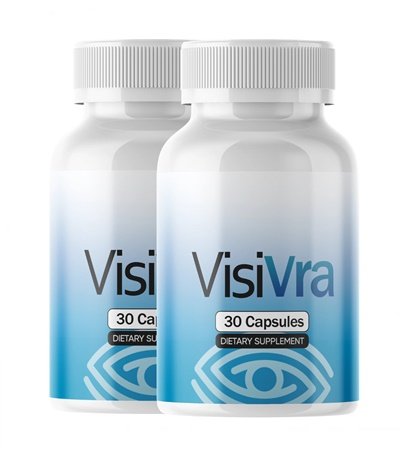
2 Bottles · 60-day supply
$79 / bottle
$158 total · about $2.80/day incl. shipping
+ $9.99 shipping
Choose 2 Bottles →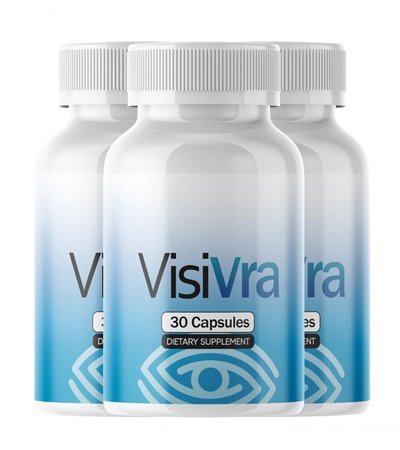
3 Bottles · 90-day supply
$59 / bottle
$177 total · about $1.97/day
Free US shipping
Choose 3 Bottles →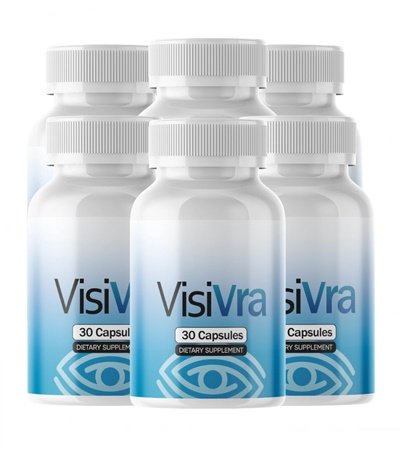
6 Bottles · 180-day supply
$49 / bottle
$294 total · about $1.63/day
Free worldwide shipping
Choose 6 Bottles →Prices as listed on the seller’s order page on October 18, 2026. Prices and shipping can change, so confirm the final total at checkout. Per-day cost assumes one bottle lasts 30 days, as implied by the seller’s “60-day / 90-day / 180-day” package labels.
For most people trying VisiVra for the first time, I suggest weighing the 3-bottle package: 90 days is long enough to judge whether you notice any difference, and it ships free in the U.S. The full comparison is on VisiVra Pricing.
The 60-day money-back guarantee
60-Day Money-Back Guarantee
The seller offers a full refund within 60 days of purchase. You must contact support first, return all bottles (empty or not) and pay return shipping yourself. Details: how the guarantee works.
The seller’s returns page asks you to contact support before sending anything back (email support@tryvisivra.com or call +1 323-347-4522), include a note with your full name, email and order ID, and return every bottle. Refunds go back to your original payment method and can take 5 to 10 business days to appear after the return is processed. Step by step, with an email template, on VisiVra Refund Steps.
Safety, side effects and who should avoid VisiVra
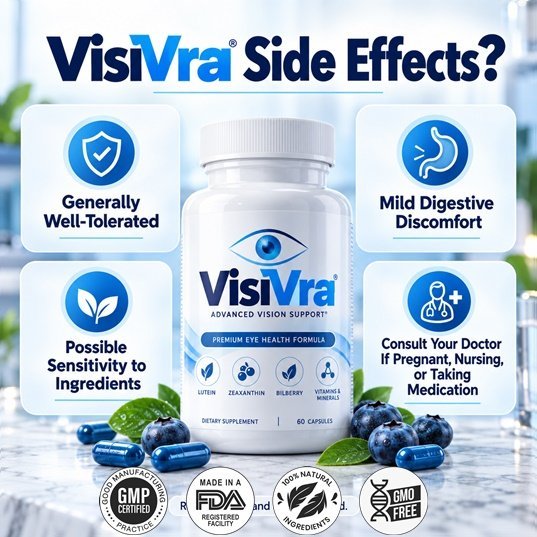
The vitamin and mineral doses are modest and unlikely to push healthy adults over safe upper limits. The botanicals are where the cautions are:
- Blood thinners: ginkgo, bilberry and Coleus forskohlii (forskolin) may each increase bleeding risk with warfarin, antiplatelet drugs, aspirin or NSAIDs.
- Diabetes medicines: alpha lipoic acid and chromium may lower blood sugar further when combined with insulin or other glucose-lowering drugs.
- Blood pressure medicines: forskolin may lower blood pressure.
- Thyroid medicine: chromium picolinate taken at the same time may reduce levothyroxine absorption.
- Pregnancy, breastfeeding and under 18s: the label says VisiVra is not for these groups, and NCCIH notes ginkgo may be unsafe in pregnancy.
The full list is on VisiVra Side Effects & Safety.
Who VisiVra may suit, and who should skip it
It may suit healthy adults who want a single daily capsule combining basic eye vitamins and minerals with lutein, zeaxanthin and other botanicals, who do not take interacting medicines, and who are comfortable with blend amounts being undisclosed because of the guarantee.
It is probably not for people diagnosed with intermediate or late AMD (an AREDS2 formula at the doses recommended by the National Eye Institute is the evidence-based choice), anyone pregnant or breastfeeding, people on blood thinners, diabetes or blood pressure medicines without their doctor’s approval, and anyone hoping a supplement will replace an eye exam or glasses. See VisiVra vs AREDS2.
Where to buy VisiVra
VisiVra is sold through the seller’s own website. Buying there is the only way to be sure your order is covered by the 60-day guarantee. Listings on marketplaces or auction sites may be expired, counterfeit or not covered by any refund. See Where to Buy VisiVra and How to Order VisiVra.
Our verdict
VisiVra is a broad, reasonably transparent eye formula with one important blind spot. Its label lists safe, modest doses of zinc, copper and vitamins A, C and E, and adds a wide range of eye-related botanicals. Its weakness is the proprietary blend: we cannot tell how much lutein, zeaxanthin, astaxanthin, bilberry or saffron each capsule contains, and with 14 ingredients sharing 351 mg, some are likely below research levels. If you are healthy, not on interacting medicines and want to try it, the 60-day guarantee is your safety net. If you have AMD, ask your eye doctor about AREDS2 instead.
For the longer analysis, read the full VisiVra Reviews page.
Frequently asked questions
What is VisiVra?
VisiVra is a one-capsule-a-day dietary supplement for eye and vision support. It contains 7 vitamins and minerals with listed doses plus a 351 mg proprietary blend of 14 botanicals and nutrients, including lutein, zeaxanthin, astaxanthin, bilberry, saffron and ginkgo.
Does VisiVra really work?
Its ingredients have research behind them, especially lutein, zeaxanthin and zinc. However, there is no published trial on the VisiVra formula, and the amounts of the blend ingredients are not disclosed, so results cannot be predicted.
How much does VisiVra cost?
On the seller’s page it costs $158 for 2 bottles plus $9.99 shipping, $177 for 3 bottles with free US shipping, or $294 for 6 bottles with free worldwide shipping.
Is there a money-back guarantee?
Yes. The seller offers a 60-day money-back guarantee. You need to contact support first, return all bottles and pay the return shipping yourself.
Is this the official VisiVra website?
No. This is an independent review site. We may earn a commission if you buy through our paid links, at no extra cost to you.
Sources
- VisiVra Supplement Facts label (product bottle, lot EVIB_211_03_050626)
- National Eye Institute – AREDS 2 Supplements for Age-Related Macular Degeneration
- AREDS2 Research Group – Lutein + Zeaxanthin and Omega-3 Fatty Acids for AMD, JAMA 2013
- Wilson et al. – Effect of Lutein/Zeaxanthin Intake on Macular Pigment Optical Density, Advances in Nutrition 2021
- NIH Office of Dietary Supplements – Zinc Fact Sheet
- NIH Office of Dietary Supplements – Vitamin A and Carotenoids Fact Sheet
- NIH Office of Dietary Supplements – Vitamin C Fact Sheet
- NIH Office of Dietary Supplements – Vitamin E Fact Sheet
- NCCIH – Bilberry: Usefulness and Safety
- NCCIH – Ginkgo: Usefulness and Safety
- Memorial Sloan Kettering – Forskolin (Coleus forskohlii)
- Memorial Sloan Kettering – Alpha-Lipoic Acid
- NIH Office of Dietary Supplements – Chromium Fact Sheet
- Giannaccare et al. – Clinical Applications of Astaxanthin in Ocular Diseases, Marine Drugs 2020
- Ferrara & Schloss – Does Crocus sativus (Saffron) Have an Effect on Ocular Health? A Systematic Review, J Evid Based Integr Med 2026
- American Academy of Ophthalmology – Should You Be Worried About Blue Light?
- U.S. FDA – Dietary Supplements
- VisiVra seller – Return Policy
- VisiVra seller – Terms of Service
*These statements have not been evaluated by the Food and Drug Administration. This product is not intended to diagnose, treat, cure, or prevent any disease. Read our medical disclaimer.