How Does VisiVra Work? The Science Behind Each Ingredient
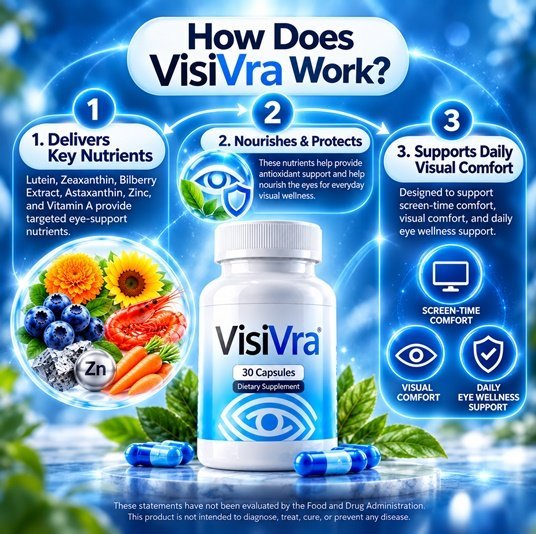
VisiVra relies on four biological ideas: building macular pigment, adding antioxidants, supplying vision nutrients and easing eye strain. Here is how each works and how strong the evidence is.
To understand how VisiVra is meant to work, it helps to know a little about the eye. Light enters through the cornea and lens and lands on the retina, a thin layer of tissue at the back of the eye. At the centre of the retina is the macula, a small area packed with cone cells that gives you sharp, detailed, colour vision for reading, driving and recognising faces. The retina is one of the most metabolically active tissues in the body. It uses large amounts of oxygen and is exposed to light all day, which makes it particularly vulnerable to oxidative stress.
VisiVra’s formula targets that environment through four mechanisms. Below I explain each, which ingredients drive it, and how confident we can be.
Mechanism 1: Building macular pigment
Lutein and zeaxanthin are the only carotenoids that collect in high concentrations in the macula, where together they form the yellow macular pigment. Zeaxanthin is densest at the very centre (the fovea), and lutein spreads more widely across the macula.
Macular pigment does two jobs. It acts as a natural filter for high-energy visible blue light before it reaches the light-sensitive cells, and it neutralises reactive oxygen species. Higher macular pigment optical density (MPOD) has been associated in research with better glare tolerance and contrast.
Evidence strength: good. A 2021 systematic review and meta-analysis in Advances in Nutrition pooled 46 studies with 3,189 participants and found that lutein and zeaxanthin intake increased MPOD in a dose-dependent way. Intakes of 5 to 20 mg a day produced a modest increase, while 20 mg or more produced a larger one. Doses below 5 mg did not produce a significant change. The authors also noted that the minimum dose needed for a clinically important change is still unknown.
VisiVra lists lutein and zeaxanthin inside a 351 mg proprietary blend shared with 12 other ingredients, so we cannot say which of these groups it belongs to.
Mechanism 2: Antioxidant protection
Oxidative stress happens when unstable molecules called free radicals outnumber the body’s antioxidant defences. In the retina, light exposure and high oxygen use generate these molecules constantly. Over decades, oxidative damage is thought to contribute to age-related changes in the eye.
Several VisiVra ingredients have antioxidant activity:
- Astaxanthin is a red carotenoid found in microalgae, salmon and shrimp. A 2020 review in Marine Drugs describes antioxidant, anti-inflammatory and anti-apoptotic effects in laboratory and animal studies.
- Bilberry contains anthocyanins, the purple-blue pigments also found in blueberries, which act as antioxidants in the lab.
- Lutein and zeaxanthin act as antioxidants within the macula itself.
- Zinc and copper are cofactors for antioxidant enzymes, including superoxide dismutase, and selenium is part of glutathione peroxidase enzymes.
- Vitamins C and E (90 mg and 15 mg per capsule) are classic antioxidant vitamins and part of the AREDS formulas, though at much lower doses here.
- Grape seed extract, quercetin, rutin, lycopene and alpha lipoic acid in the blend also show antioxidant activity in laboratory studies.
Evidence strength: mixed. Antioxidant activity in a test tube does not always translate into measurable benefits in people. The most convincing human evidence comes from the AREDS trials, which tested specific antioxidant and mineral combinations in people with AMD.
Mechanism 3: Supplying nutrients needed for vision
Vitamin A is part of rhodopsin, the light-sensitive pigment in rod cells that lets you see in dim light. According to the NIH Office of Dietary Supplements, the first sign of vitamin A deficiency is night blindness, and severe deficiency can lead to xerophthalmia and permanent blindness. Deficiency is rare in the United States but common in some low-income countries.
Zinc is highly concentrated in the retina and helps move vitamin A from the liver to the retina, where it is used to make rhodopsin.
Evidence strength: strong for the biology, limited for extra benefit. If you are already getting enough vitamin A and zinc from food, taking more is unlikely to sharpen your vision, and very high amounts can cause harm.
Mechanism 4: Easing eye strain
The seller says VisiVra helps eyes adapt to daily strain. The ingredient most often studied for this is astaxanthin, mainly in small Japanese trials that measured eye fatigue and the eye’s ability to focus (accommodation). Bilberry is also sometimes combined with astaxanthin in eye-strain products.
Evidence strength: early. The Marine Drugs review lists asthenopia (eye strain) among the conditions where astaxanthin shows promise, but its authors call for long-term trials to establish proper dosing. For most people, the most effective tools for digital eye strain are behavioural: regular breaks, conscious blinking, good lighting and correct screen distance. See our digital eye strain guide.
What about blue light protection?
Lutein and zeaxanthin do absorb blue light within the macula. However, the seller’s implication that screen blue light needs defending against is not supported by the American Academy of Ophthalmology, which says there is no scientific evidence that blue light from digital devices causes eye damage. Sunlight is a far bigger source of blue light than any screen. Read more in Does Blue Light Damage Your Eyes?.
Putting it together
| Mechanism | Ingredients | Evidence | Key unknown |
|---|---|---|---|
| Macular pigment | Lutein, zeaxanthin | Good (meta-analysis) | Amount inside the blend |
| Antioxidant support | Astaxanthin, bilberry, carotenoids, zinc | Mixed | Real-world benefit in healthy eyes |
| Vision nutrients | Vitamin A, zinc | Strong biology | Benefit if not deficient |
| Eye strain | Astaxanthin, bilberry | Early | Dose and long-term effect |
The mechanisms behind VisiVra are scientifically reasonable. What we cannot confirm is whether one serving supplies enough of each ingredient to produce the effects seen in studies. That is the single most important question to put to the seller before you buy.
Frequently asked questions
How long does it take for lutein to build macular pigment?
In the studies pooled in the 2021 meta-analysis, macular pigment was measured after 3 to 12 months of supplementation.
Can VisiVra repair damaged eyes?
No supplement can repair existing damage or restore lost vision. VisiVra may support normal eye function, but it is not a treatment for eye disease.
Does VisiVra block blue light?
Lutein and zeaxanthin absorb blue light inside the macula, but eye health authorities say screen blue light is not known to damage the eye.
Sources
- VisiVra Supplement Facts label (product bottle, lot EVIB_211_03_050626)
- Wilson et al. – Effect of Lutein/Zeaxanthin Intake on Macular Pigment Optical Density, Advances in Nutrition 2021
- AREDS2 Research Group – Lutein + Zeaxanthin and Omega-3 Fatty Acids for AMD, JAMA 2013
- National Eye Institute – AREDS 2 Supplements for Age-Related Macular Degeneration
- NIH Office of Dietary Supplements – Vitamin A and Carotenoids Fact Sheet
- NIH Office of Dietary Supplements – Zinc Fact Sheet
- NIH Office of Dietary Supplements – Vitamin C Fact Sheet
- NIH Office of Dietary Supplements – Vitamin E Fact Sheet
- NIH Office of Dietary Supplements – Selenium Fact Sheet
- Giannaccare et al. – Clinical Applications of Astaxanthin in Ocular Diseases, Marine Drugs 2020
- NCCIH – Bilberry: Usefulness and Safety
- American Academy of Ophthalmology – Should You Be Worried About Blue Light?
- American Academy of Ophthalmology – Computers, Digital Devices, and Eye Strain
*These statements have not been evaluated by the Food and Drug Administration. This product is not intended to diagnose, treat, cure, or prevent any disease. Read our medical disclaimer.