VisiVra Ingredients: All 21 Explained With the Evidence
VisiVra combines seven dosed vitamins and minerals with a 351 mg proprietary blend of 14 botanicals and nutrients. Here is what each one does, how strong the research is, and what the label does and does not tell you.
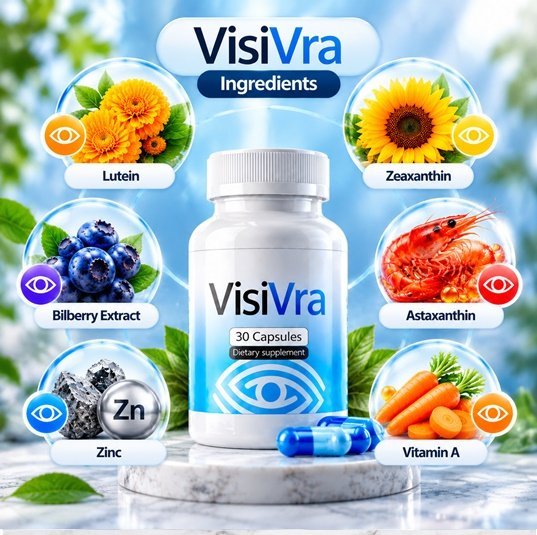
The ingredient list is the heart of any supplement review. The seller’s sales page highlights six ingredients, but the bottle’s Supplement Facts label shows the full formula of 21. I have written dedicated pages for the six headline ingredients; this hub covers all of them, including the 15 the sales page does not mention.
The VisiVra label
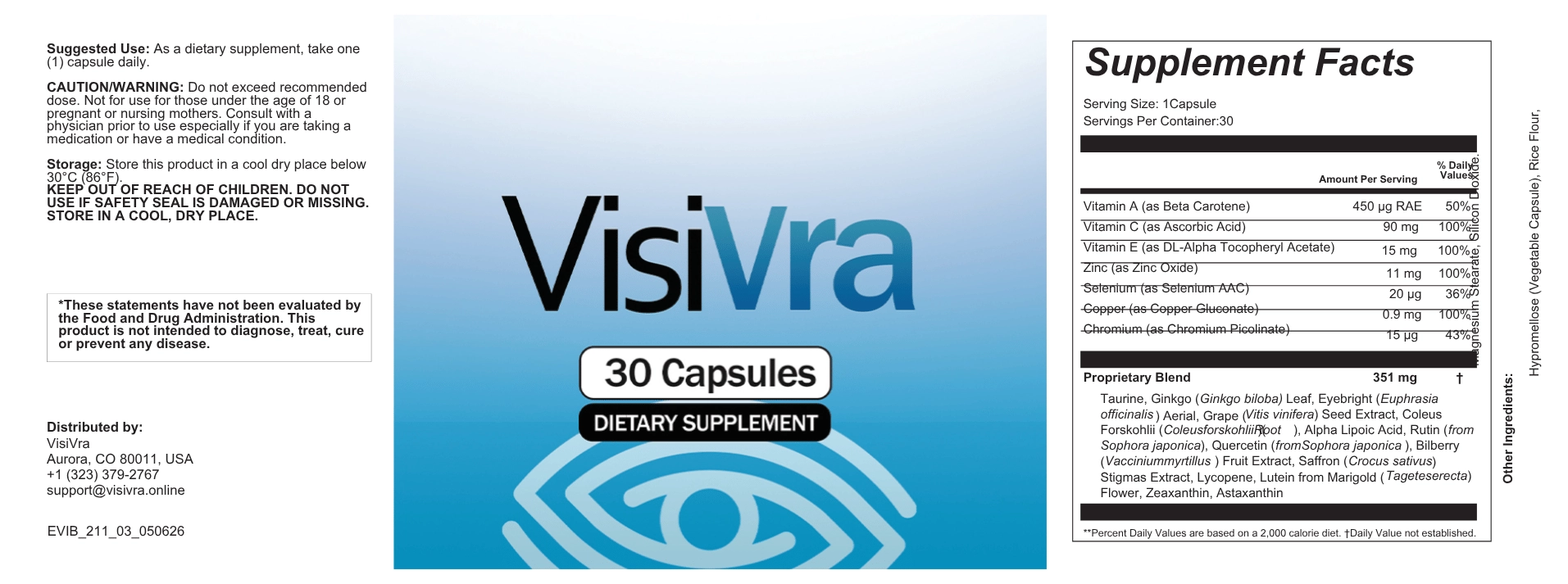
| Supplement Facts (1 capsule) | Amount per serving | % Daily Value |
|---|---|---|
| Vitamin A (as beta-carotene) | 450 mcg RAE | 50% |
| Vitamin C (as ascorbic acid) | 90 mg | 100% |
| Vitamin E (as DL-alpha tocopheryl acetate) | 15 mg | 100% |
| Zinc (as zinc oxide) | 11 mg | 100% |
| Selenium (as selenium AAC) | 20 mcg | 36% |
| Copper (as copper gluconate) | 0.9 mg | 100% |
| Chromium (as chromium picolinate) | 15 mcg | 43% |
| Proprietary Blend | 351 mg | † |
Proprietary blend (351 mg): Taurine, Ginkgo (Ginkgo biloba) leaf, Eyebright (Euphrasia officinalis) aerial parts, Grape (Vitis vinifera) seed extract, Coleus forskohlii root, Alpha lipoic acid, Rutin (from Sophora japonica), Quercetin (from Sophora japonica), Bilberry (Vaccinium myrtillus) fruit extract, Saffron (Crocus sativus) stigma extract, Lycopene, Lutein (from marigold, Tagetes erecta, flower), Zeaxanthin, Astaxanthin. †Daily Value not established. Other ingredients: hypromellose (vegetable capsule), rice flour, magnesium stearate, silicon dioxide. Transcribed from the product label (lot EVIB_211_03_050626).
The complete ingredient list
| Ingredient | Amount per capsule | Main role | Eye evidence | More |
|---|---|---|---|---|
| Lutein | In blend | Macular pigment | Good | Full guide |
| Zeaxanthin | In blend | Central macular pigment | Good (with lutein) | Full guide |
| Astaxanthin | In blend | Antioxidant; eye strain | Early | Full guide |
| Bilberry fruit extract | In blend | Anthocyanin antioxidants | Weak / mixed | Full guide |
| Zinc (oxide) | 11 mg | Retinal enzymes, vitamin A transport | Good (AREDS, at 80 mg) | Full guide |
| Vitamin A (beta-carotene) | 450 mcg RAE | Rhodopsin for low-light vision | Strong biology | Full guide |
| Vitamin C | 90 mg | Antioxidant | AREDS nutrient (at 500 mg) | See below |
| Vitamin E | 15 mg | Antioxidant | AREDS nutrient (at 180 mg) | See below |
| Copper (gluconate) | 0.9 mg | Balances zinc | AREDS nutrient (at 2 mg) | See below |
| Selenium | 20 mcg | Antioxidant enzymes | No specific eye evidence | See below |
| Chromium (picolinate) | 15 mcg | Glucose metabolism | No specific eye evidence | See below |
| Saffron stigma extract | In blend | Carotenoid-rich spice | Early clinical trials | See below |
| Ginkgo leaf | In blend | Circulation (traditional) | Limited | See below |
| Eyebright | In blend | Traditional eye herb | Very limited | See below |
| Grape seed extract | In blend | Polyphenol antioxidants | Limited | See below |
| Coleus forskohlii root | In blend | Forskolin | Limited | See below |
| Alpha lipoic acid | In blend | Antioxidant | Limited | See below |
| Rutin, quercetin | In blend | Flavonoid antioxidants | Laboratory only | See below |
| Taurine | In blend | Amino acid abundant in the retina | Laboratory only | See below |
| Lycopene | In blend | Tomato carotenoid | Limited | See below |
The dose question: open label, hidden blend
VisiVra gets credit for listing exact amounts and forms for all seven vitamins and minerals. These are set at or below 100% of the Daily Value, which is safe for long-term use but much lower than the doses tested in AREDS and AREDS2 (500 mg vitamin C, 180 mg vitamin E, 80 mg zinc and 2 mg copper).
The ingredients most associated with eye health are a different story. Lutein, zeaxanthin, astaxanthin, bilberry and saffron share a 351 mg proprietary blend with nine other ingredients. For context, research doses include about 10 mg of lutein (AREDS2), 20 to 50 mg of saffron (clinical trials) and up to 160 mg of bilberry extract (studies reviewed by NCCIH). Fourteen ingredients in 351 mg means some of them are likely present at less than research amounts, but without disclosure nobody outside the company can say which.
Vitamins and minerals
Vitamin C (90 mg) and vitamin E (15 mg)
Both are antioxidant vitamins and part of the AREDS formulas. VisiVra provides the adult RDA of each (90 mg vitamin C for men, 15 mg vitamin E for adults), well below the upper limits of 2,000 mg and 1,000 mg. The NIH notes that AREDS used 500 mg of vitamin C and 400 IU (180 mg) of vitamin E, and that antioxidants have been shown to slow AMD progression in high-risk people, not to prevent AMD.
Copper (0.9 mg)
Copper is included to balance zinc, because long-term high zinc intake can reduce copper absorption. The AREDS formulas include 2 mg for the same reason. At 11 mg zinc, VisiVra is unlikely to cause copper problems, but including copper is good formulation practice.
Selenium (20 mcg)
Selenium is part of antioxidant enzymes called glutathione peroxidases. The adult RDA is 55 mcg and the U.S. upper limit is 400 mcg, so 20 mcg is a small, safe amount. There is no specific evidence that selenium supplements benefit the eyes.
Chromium (15 mcg)
Chromium is involved in glucose metabolism. Adults’ adequate intake is 20 to 35 mcg a day and no upper limit has been set. The NIH notes it may increase insulin sensitivity, so people on diabetes medicines should check with their doctor, and chromium picolinate may reduce levothyroxine absorption if taken at the same time.
Botanicals and other blend ingredients
Saffron
Saffron, from the stigmas of the Crocus sativus flower, is rich in carotenoid-like compounds called crocin and crocetin. A 2026 systematic review in the Journal of Evidence-Based Integrative Medicine found ten clinical trials of saffron and its compounds in eye conditions, including age-related macular degeneration and glaucoma, typically at 20 to 50 mg of saffron a day for 6 weeks to 12 months. The authors reported encouraging results and good safety but called for larger trials. VisiVra does not disclose how much saffron it contains.
Ginkgo leaf
Ginkgo is promoted for circulation and memory. NCCIH describes ginkgo leaf extract as generally well tolerated, with dizziness, stomach upset and headache as the most common side effects. It warns that ginkgo may increase bleeding risk with anticoagulants such as warfarin and may be unsafe in pregnancy. Evidence for eye benefits is limited.
Eyebright
Eyebright (Euphrasia officinalis) is a traditional European herb whose name reflects its historic use for eye complaints. There is very little clinical research on taking it by mouth for eye health.
Grape seed extract
Grape seed extract is rich in polyphenol antioxidants. NCCIH reports it is generally well tolerated and summarises reviews suggesting small effects on LDL cholesterol and diastolic blood pressure, but it does not list proven eye benefits.
Coleus forskohlii (forskolin)
Coleus forskohlii root is the source of forskolin, used in Ayurvedic medicine. Memorial Sloan Kettering notes that clinical evidence for its safety and effectiveness is lacking, and that it may lower blood pressure and slow heart rate, add to the effect of blood pressure medicines, and increase bleeding risk with blood thinners. People with polycystic kidney disease should avoid it.
Alpha lipoic acid
Alpha lipoic acid is an antioxidant made naturally in the body. Memorial Sloan Kettering lists nausea and low blood sugar among its side effects and warns it may add to the effect of diabetes medicines and may interfere with chemotherapy and radiation.
Rutin and quercetin
These related flavonoids, here sourced from the Japanese pagoda tree (Sophora japonica), show antioxidant and blood-vessel effects in laboratory studies. Human evidence for eye benefits is lacking.
Taurine
Taurine is an amino acid found in high concentrations in the retina, where it is thought to help protect photoreceptor cells. Most of the evidence comes from laboratory and animal research; the body also makes taurine, and it is plentiful in meat and fish.
Lycopene
Lycopene is the red carotenoid in tomatoes and watermelon. Unlike lutein and zeaxanthin, it does not concentrate in the macula, and evidence for eye benefits is limited.
How the ingredients fit together
- The AREDS-style core: lutein, zeaxanthin, zinc, copper and vitamins C and E, at much lower doses than AREDS2.
- Extra eye carotenoids: astaxanthin, saffron and lycopene.
- Botanicals and antioxidants: bilberry, ginkgo, eyebright, grape seed, forskolin, alpha lipoic acid, rutin, quercetin and taurine.
- General micronutrients: vitamin A as beta-carotene, selenium and chromium.
This is a coherent “everything for the eyes” design. The trade-off is that breadth comes at the expense of dose for the blend ingredients, and several botanicals bring drug interactions. See the side effects and safety page.
Our assessment of the formula
VisiVra’s label is more transparent than its sales page: the micronutrients are clearly and safely dosed, and the choice of beta-carotene, zinc oxide with copper, and lutein with zeaxanthin reflects established eye nutrition research. The real limitations are that the micronutrient doses are nutritional rather than therapeutic, and that the eye-specific botanicals are hidden in a proprietary blend. Four of the six fat-soluble ingredients are best absorbed with food; see How to Take VisiVra.
Frequently asked questions
How many ingredients are in VisiVra?
21: seven vitamins and minerals with listed doses, and 14 ingredients in a 351 mg proprietary blend.
Does VisiVra contain copper?
Yes, 0.9 mg per capsule as copper gluconate, which balances the 11 mg of zinc.
How much lutein is in VisiVra?
The label does not say. Lutein is part of a 351 mg proprietary blend shared with 13 other ingredients.
Does VisiVra contain ginkgo?
Yes, ginkgo leaf is in the proprietary blend. Ginkgo may increase bleeding risk with blood thinners, so check with your doctor if you take them.
Sources
- VisiVra Supplement Facts label (product bottle, lot EVIB_211_03_050626)
- National Eye Institute – AREDS 2 Supplements for Age-Related Macular Degeneration
- AREDS2 Research Group – Lutein + Zeaxanthin and Omega-3 Fatty Acids for AMD, JAMA 2013
- Wilson et al. – Effect of Lutein/Zeaxanthin Intake on Macular Pigment Optical Density, Advances in Nutrition 2021
- NIH Office of Dietary Supplements – Vitamin C Fact Sheet
- NIH Office of Dietary Supplements – Vitamin E Fact Sheet
- NIH Office of Dietary Supplements – Zinc Fact Sheet
- NIH Office of Dietary Supplements – Selenium Fact Sheet
- NIH Office of Dietary Supplements – Chromium Fact Sheet
- NIH Office of Dietary Supplements – Vitamin A and Carotenoids Fact Sheet
- Ferrara & Schloss – Does Crocus sativus (Saffron) Have an Effect on Ocular Health? A Systematic Review, J Evid Based Integr Med 2026
- NCCIH – Ginkgo: Usefulness and Safety
- NCCIH – Grape Seed Extract: Usefulness and Safety
- Memorial Sloan Kettering – Forskolin (Coleus forskohlii)
- Memorial Sloan Kettering – Alpha-Lipoic Acid
- NCCIH – Bilberry: Usefulness and Safety
- EFSA – Safety of astaxanthin for its use as a novel food in food supplements
- Giannaccare et al. – Clinical Applications of Astaxanthin in Ocular Diseases, Marine Drugs 2020
*These statements have not been evaluated by the Food and Drug Administration. This product is not intended to diagnose, treat, cure, or prevent any disease. Read our medical disclaimer.